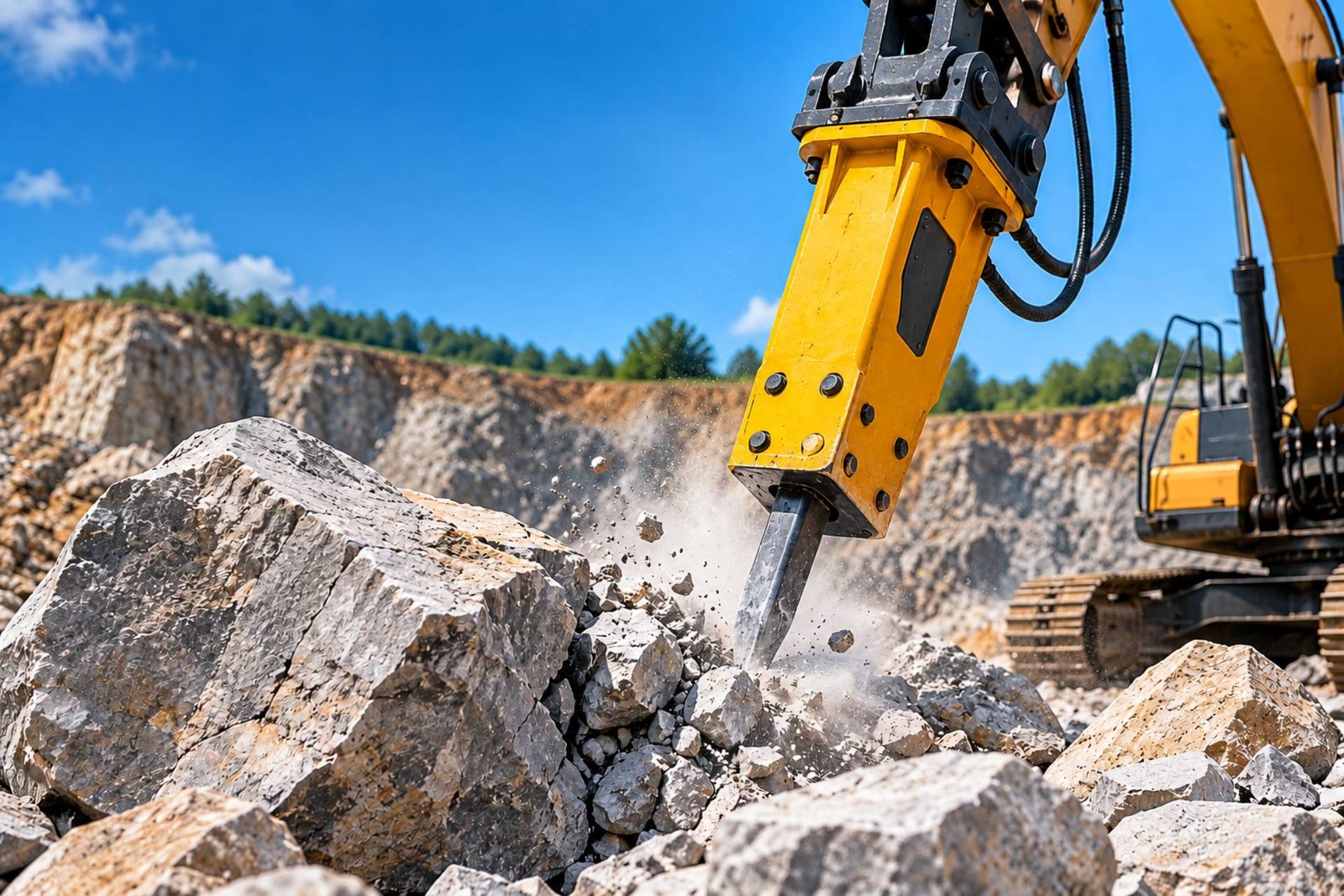
Oversized material and blockages remain common challenges in mining, quarrying and heavy construction. Large rocks that fail to pass through primary crushers or grizzlies can halt production, increase wear on downstream equipment and create safety risks for operators who must clear them by hand.
Selecting suitable rock breakers is therefore a practical decision that affects productivity, equipment life and site safety. The right attachment breaks material efficiently while matching the carrier, rock type and operating conditions of the job.
Understanding the Task
Secondary breaking deals with rocks that are too large after blasting or loading. These oversize pieces often lodge in crusher feeders, on grizzlies or inside the crusher chamber itself. A hydraulic breaker delivers repeated high-energy blows to fracture the rock into smaller, manageable sizes so material flow can resume.
Blockage clearing follows a similar principle. When material bridges or jams, the breaker is used to free the obstruction without the need for manual intervention in hazardous zones. In both cases the goal is controlled fragmentation rather than primary excavation. The equipment must therefore deliver sufficient impact energy while remaining durable under continuous or frequent use.
Key Factors to Consider
Several practical points guide the choice of a suitable breaker. Matching these factors to the site conditions reduces the risk of under-performance or premature wear.
- Rock hardness and boulder size. Softer sedimentary rock needs less impact energy than hard igneous or metamorphic material. Larger boulders generally require a heavier breaker with a larger tool diameter to achieve effective penetration and fracture.
- Carrier compatibility. The breaker must sit within the recommended weight range of the excavator or stationary boom. An oversized unit strains the carrier hydraulics and structure; an undersized one lacks the power to complete the work efficiently.
- Duty cycle. Intermittent use on a construction site differs from continuous secondary breaking at a crusher. Continuous applications favour robust housings, effective damping systems and components designed for prolonged operation.
- Working environment. Dust, moisture, confined underground spaces or extreme temperatures influence seal quality, tool retention and cooling requirements.
These considerations form the foundation of a reliable selection process. Ignoring any one of them can lead to frequent downtime or higher operating costs.
Matching Breaker Size and Mounting Style
Hydraulic breakers are commonly grouped by working weight and the carrier size they suit. Smaller units attach to mini-excavators for lighter tasks or restricted access. Medium and large models pair with heavier excavators or pedestal-mounted boom systems for primary crusher areas and grizzly stations.
Stationary boom installations are particularly useful for blockage clearing. The boom positions the breaker precisely over the feed point or crusher mouth, allowing operators to work from a safe distance. Mobile excavator-mounted units offer greater flexibility for scattered oversize material across a quarry floor or stockpile.
Side-mounted configurations can improve visibility and reach in certain layouts. Tool diameter also matters: larger diameters transfer more energy into hard rock, while the correct chisel or moil point shape concentrates force effectively. Always confirm that the hydraulic flow and pressure of the carrier match the breaker’s requirements so impact performance remains consistent.
Practical Steps for Reliable Operation
Once the size and style are chosen, everyday practices determine how well the equipment performs over time.
- Position the tool squarely on the rock surface and maintain steady downward pressure. Glancing blows waste energy and accelerate wear on both the tool and housing.
- Allow the breaker to work at its designed impact rate rather than forcing continuous high-frequency operation, which can overheat the unit.
- Inspect the working tool, retaining pins and hydraulic hoses at the start of each shift. Replace worn tools before they cause secondary damage.
- Keep the hydraulic system clean and at the correct oil temperature. Contaminated or overheated oil reduces impact force and shortens component life.
- Train operators to recognise when a rock is too large or too hard for the current set-up, so that alternative methods can be considered without risking the machine.
These steps are straightforward yet frequently overlooked. Consistent attention to them extends service intervals and keeps production moving.
Common Issues and When Professional Advice Helps
Frequent problems include insufficient impact energy for the rock type, excessive vibration transmitted to the carrier, and rapid tool wear. These usually stem from a mismatch between breaker size and application rather than a manufacturing fault. In confined underground settings, limited boom reach or restricted carrier size can further complicate selection.
When the operation involves continuous high-volume secondary breaking, specialised mining-grade units with reinforced housings and higher operating pressures often prove more suitable than standard construction models. Site-specific factors such as available space, power supply for stationary systems and local rock characteristics also influence the final choice.
In these situations it is wise to consult an experienced equipment supplier or application specialist. They can review carrier specifications, measure typical boulder sizes and recommend a configuration that balances power, reach and durability. Professional input is especially valuable when integrating a new breaker into an existing boom system or when production targets leave little margin for trial and error.
Bringing It All Together
Choosing the correct equipment for oversize and blockage clearing rests on a clear understanding of the material, the carrier and the working environment. Matching impact energy to rock hardness, ensuring hydraulic compatibility and following basic operating practices all contribute to reliable performance and lower long-term costs.
Careful selection of rock breakers, combined with regular maintenance and operator awareness, keeps material flowing and reduces the need for risky manual intervention. Assess the specific demands of the site, seek specialist advice when conditions are demanding, and the resulting set-up will support steady, productive operations.